In this post
SEO for Doctors: How to Get Your Practice Found on Google
- The Core Issue: Many practices pour budget into ads or run outdated websites and miss patients who are actively searching for local care. Healthcare SEO is also harder than most, with strict advertising rules and Google’s E-E-A-T standards (Experience, Expertise, Authoritativeness, Trustworthiness) to meet.
- The Solution: Build lasting organic visibility by prioritizing Local SEO, writing well-structured service pages that show real E-E-A-T, and formatting content so AI tools like ChatGPT and Gemini can extract and cite it.
- Quick Win: Skip straight to Google Business Profile: your digital practice sign. This section shows you how to set up the profile that gets practices into Google’s Local Pack.
Many people still start their search for a doctor on Google. That makes search engine optimization (SEO) one of the most effective marketing tools a practice has. And yet, plenty of practices spend thousands of dollars on websites that are technically outdated, offer no relevant content, and ultimately win over neither patients nor Google.
It doesn’t have to be that way. With a focused SEO strategy, you can reach exactly the patients who are actively searching for your services, with no ongoing ad spend. This article shows you:
- what makes SEO for doctors different
- how to find the right keywords for your practice
- what content a modern practice website needs
- and how to build authority through link building.
What is SEO for doctors, and is it worth it?
SEO stands for search engine optimization. For a medical practice, that means building your website and online presence so that search engines like Google rank you as high as possible when potential patients search for your specialty or a treatment. The key difference from search engine advertising (SEA) is that you don’t pay per click. Instead, you invest once in structure, content, and technology, and benefit long-term from free, organic traffic.
SEO vs. Google Ads: the difference
What makes SEO for doctors different
People search for medical topics differently than they do for, say, electronics or fashion. Here’s what typical searches look like in the medical field:
| Search type | Example keywords | Search intent |
|---|---|---|
| Specialty + location | “dermatologist Chicago Lincoln Park” | Patient is looking for a nearby practice (navigational) |
| Symptom search | “knee pain what to do” | Wants information, no visit planned yet (informational) |
| Treatment + location | “teeth whitening Denver” | Researching a specific treatment (transactional) |
| Doctor’s name | “Dr. Miller orthopedist Austin” | Already knows the practice, wants details (transactional or navigational) |
| Reviews | “best eye doctor Seattle reviews” | Comparing options and deciding (informational) |
The competitive landscape
Search behavior is only half the picture. The competition matters just as much. Yelp alone lists over 300 dental practices in a mid-sized city like Columbus, Ohio. Neglect SEO here, and you’ll have almost no chance of landing in Google’s top results for local searches, no matter how good you are clinically. At that point, Google isn’t asking who the better doctor is. It’s asking who has the better online presence.
Legal advertising restrictions
Doctors face stricter marketing rules than almost any other profession. In the US, medical advertising is governed by the FTC’s truth-in-advertising rules, your state medical board’s regulations, and the AMA Code of Medical Ethics. Together, they prohibit false, misleading, or unsubstantiated claims, including guarantees of specific results and unprovable claims of superiority. You can still use patient testimonials and before-and-after photos, but only if they’re genuine, representative of typical results, and backed by proper patient consent.
For your SEO, this means keeping your title tags, meta descriptions, and content factual. Phrasing like “best dentist in town” or “guaranteed pain-free” is off-limits, and so are splashy promises of success in FAQ blocks or snippet text. Get this right, and you’ll avoid complaints or disciplinary action while building lasting trust, with Google and with prospective patients alike.
The business case: why SEO pays off for doctors
At first, search engine marketing seems like the easy route: run a few Google Ads, and your practice shows up at the top for relevant searches. But there’s a catch:
Google Ads cost money continuously and stop working the moment your budget runs out. SEO takes more effort upfront and only really pays off after a few months, but it builds organic reach for the long haul without racking up new costs along the way. Traditional SEO also has advantages over other channels like Healthgrades:
| Channel | Cost per patient or month | Sustainability | Time investment |
|---|---|---|---|
| SEO | Low after the setup phase | High: once it’s set up, SEO works for the long term | High at first, then moderate |
| Google Ads | Several dollars per click, depending on the keyword | None: stops the moment your budget runs out | Ongoing (campaign management) |
| Healthgrades (paid profile) | From about $120/month | Depends on the platform | Low |
| Referrals / word of mouth | Free | High, but doesn’t scale | Not something you can control |
So if you want to reach patients online, you can’t skip SEO. Below, we’ll look at the five core areas of SEO for doctors:
1. Local SEO: Makes your practice visible for location-based searches like “family doctor Chicago Loop.”
2. On-page SEO: Covers the content and structure of your website, from keywords and headings to meta tags.
3. Technical SEO: Makes sure your website loads fast, works flawlessly on mobile, and can be crawled by Google without issues.
4. Off-page SEO: Strengthens your practice website’s authority through backlinks, directory listings, and external referrals.
5. Generative Engine Optimization (GEO): Optimizes your content so AI tools like ChatGPT and Google Gemini use it as a source.
1. Local SEO: the biggest lever for medical practices
For most medical practices, local SEO does the heavy lifting. The reason is simple: when patients look for a doctor, they almost always mean a doctor near them. Optimizing for local results is what determines whether you show up in the Local Pack. That’s the set of three practices Google displays right under the map:
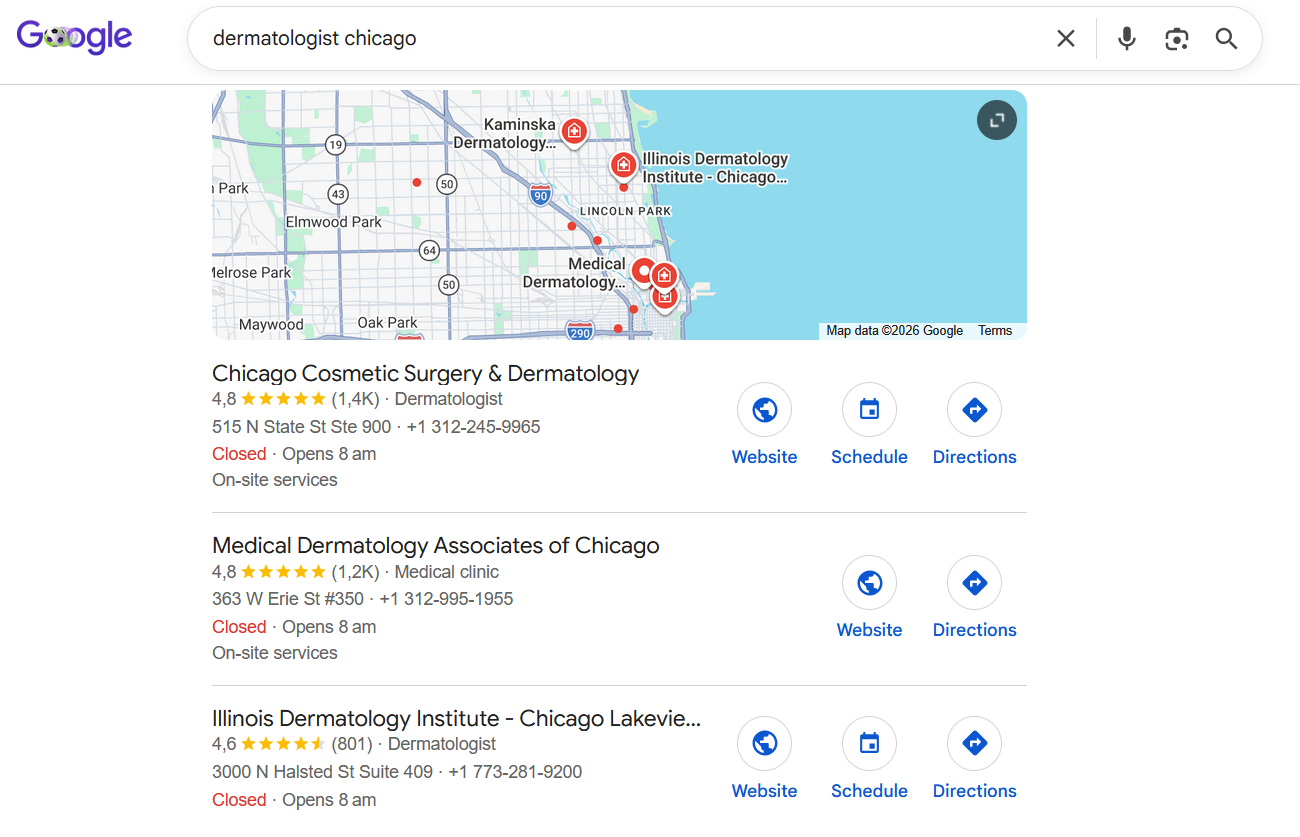
For many patients, the Local Pack can be the first point of contact with a practice.
You have several ways to improve your chances of appearing in the Local Pack. The most important ones are a Google Business Profile, optimizing for local keywords, active review management, and a consistent presence across directories. Let’s take a closer look:
Google Business Profile: your digital practice sign
Your Google Business Profile (formerly Google My Business) is where your local visibility starts. It’s free, and it works like a business card for your practice, so you’ll want to keep it current and looking sharp:
Checklist: how to optimize your Google Business Profile
- Practice name: Use the exact name shown on your practice sign (avoid keyword stuffing like “Dr. Miller, Best Dentist in Chicago”).
- Categories: Set the correct primary category (e.g., “Dentist” instead of “Doctor”) and add up to 9 relevant secondary categories.
- Hours: Keep your hours up to date, and add special hours for holidays or vacation days.
- Professional photos: Upload at least 10 high-quality images of your practice, your team, and your reception area.
- Service descriptions: Write a detailed description of your services and work in relevant keywords naturally.
- Google Posts: Publish regular posts with news, tips, or team updates to keep your profile active.
You’ll find more tips in our complete guide to optimizing your Google Business Profile.
Finding and using local keywords
Your website and Google Business Profile should cover the local keywords that matter most. These usually combine your specialty or a treatment with a location. The trick is landing on the combinations your patients actually search for.
Keywords generally fall into two types: short-tail and long-tail keywords. Each comes with trade-offs. Short search terms like “dentist Chicago” usually have high search volume, but they’re often fiercely competitive. Longer search terms like “dentist for anxiety patients Chicago Rogers Park” have lower search volume, but they tend to convert much better because the search intent is far more specific.
Here’s our full guide to local keyword research.
💡 Tip: Use free tools like Google Suggest (autocomplete), “related searches,” or Seobility’s Keyword Research Tool to find relevant local keywords. We’ll cover how to choose the right keywords in the on-page SEO section.
Review management: Google reviews as a ranking factor
Your profile and keyword coverage aren’t the only things that affect your Google ranking. Google reviews also factor into whether your practice shows up in local results. Practices with more reviews, and higher ratings, show up in the Local Pack more often. On top of that, reviews are a huge trust factor for potential patients. That’s why review management should be a fixed part of your online strategy.
How to generate good reviews systematically:
Reach out to happy patients directly, ideally right after a successful treatment. Create a short link to your Google review profile and add it to your appointment-reminder emails, business cards, or a QR code in the waiting room. And don’t leave negative reviews unanswered.
Handling negative reviews
- Don’t ignore them: Respond to every negative review with a professional, factual reply.
- Don’t argue in public: Avoid debates in the comments and offer to sort things out by phone or email instead.
- Set the facts straight: If a review is demonstrably false, you can correct it calmly and precisely.
- Use Google’s policies: Report reviews that contain spam, insults, or false claims directly to Google.
| 💡 | Important: A practice with 4.6 stars and 70 reviews often comes across as more credible and approachable than one with a perfect 5.0 from just 10 reviews. |
Directories and portals: NAP consistency
Finally, local SEO depends on consistent NAP data (name, address, phone number). Google checks whether your practice details are consistent across every online directory. Discrepancies, like an old phone number on Healthgrades or a different spelling on Zocdoc, confuse Google and drag down your local ranking.
💡 Tip: Create a table of every directory your practice is listed in, and whenever something changes, check regularly that your name, address, and phone number are identical everywhere.
2. On-page SEO: optimizing your practice website for Google and patients
An optimized Google Business Profile can get you into the Local Pack. But for genuinely strong rankings, you also need a website that wins over both Google and your potential patients. This is where on-page SEO comes in:
Keyword strategy for practice websites
Every page on your website should target one main keyword. That might sound simple, but in practice it’s where most mistakes happen: either there’s just a generic homepage with no clear keyword focus, or every service ends up crammed onto one overloaded page.
Example of a page structure for a practice website:
| Page type | Main keyword (example) | Content |
|---|---|---|
| Homepage | dentist [city] | Overview, trust signals, internal linking |
| Service page 1 | professional teeth cleaning [city] | Detailed description, procedure, cost, FAQ |
| Service page 2 | dental implants [city] | Treatment, materials, before/after, FAQ |
| Service page 3 | dentist for anxiety patients [city] | Tailored messaging, methods, testimonials |
| Blog / how-to | tips to prevent cavities | Informational articles for symptom searchers |
| About us / team | dental practice team [city] | Doctor profiles, qualifications, photos |
| Contact | dentist [city] appointment | Address, map, online booking |
But how do you pick the right ones from thousands of keywords? A lot of it comes down to how your practice is positioned locally. Either way, you should always weigh these factors:
- Search volume: How often people search for the term each month.
- Competition: How much competition there is for that keyword.
- Cost per click: What advertisers pay per click in Google Ads.
- Search intent: What is the user trying to accomplish with this search?
💡 Tip: You have to weigh these factors against each other, because the best keyword on paper is rarely the best keyword for your practice. For example: “dentist Chicago” has high search volume but also extremely high competition. As a small practice, you’ll struggle to crack the top 10. A long-tail keyword like “dentist for anxiety patients Chicago Lincoln Park” gets searched far less often, but the intent is crystal clear and the competition is manageable.
Content quality: E-E-A-T in healthcare
Content is the heart of any website, and for medical practices, Google sets the bar especially high. Here’s why: medical content is what’s known as YMYL content, short for “Your Money or Your Life.” That means Google applies stricter standards here, because inaccurate health information can do real harm. Google’s criteria for judging this are called E-E-A-T: Experience, Expertise, Authoritativeness, and Trustworthiness.
E-E-A-T for doctors: how to meet the criteria
That means a 100-word blurb on each service page won’t cut it. Invest in well-researched, clearly written content that offers real value to patients. The following three tips show you how:
Content marketing for doctors: 3 tips for high-quality content
Tip 1: A practice blog and how-to content
A medical blog can give you a valuable SEO boost. Every solid how-to article is a chance to rank for additional keywords and bring patients to your site. Some topics that work well here:
| Topic type | Example topic |
|---|---|
| Common patient questions | What to do about bleeding gums? |
| Treatment explainers | Root canal: procedure, pain, and cost |
| Seasonal topics | Hay fever in spring: what actually helps |
| Myth-busting | Does coffee damage your teeth? |
| Prevention tips | Colon cancer screening after 45: what you need to know |
One rule for your blog: consistency beats volume. Two solid articles a month do more than two shallow ones a week. Google rewards quality and freshness.
Tip 2: FAQ sections and pages
FAQ sections on your service pages, or as their own page, are an often-underrated SEO tactic. They answer real patient questions while also boosting your chances of landing a Featured Snippet, the result that sits above all the others (position 0). FAQs also pull their weight in AI search: ChatGPT, Perplexity, and the like tend to draw on clearly structured question-and-answer pairs, because they slot neatly into the answers these tools generate.
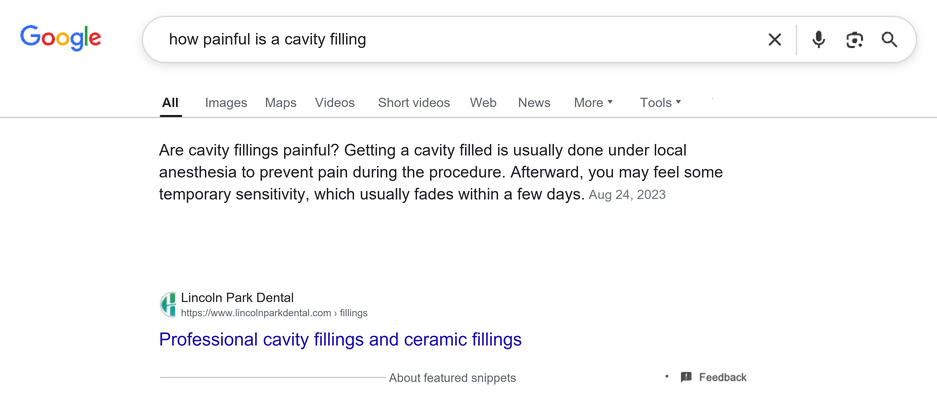
Explaining common patient questions clearly and concisely improves your chances of landing in the featured snippets.
Tip 3: Visual elements
Patients want to see where they’ll be treated and by whom. Professional photos of your practice, your team, and your rooms are another important trust factor, and ultimately a ranking boost.
Practically speaking: invest in a professional photo shoot. You can then use the images on your website, in your Google Business Profile, on social media, and in press articles. That single shoot pays for itself many times over.
Explainer videos are worth the effort: a two-minute video walking patients through a common treatment builds trust and can drive extra visibility on both YouTube and your website.
Meta tags
High-quality content isn’t everything. Don’t neglect your meta tags, especially the meta title and meta description. They’re often a user’s first impression of your site:
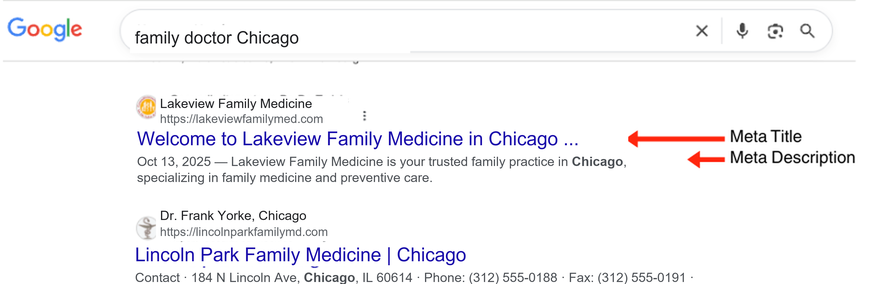
Tips for a great meta title:
- Recommended length: 50 to 60 characters
- Includes the focus keyword of the page (as early as possible)
- Sparks interest without overdoing it (no clickbait!)
Tips for a great meta description:
- Length: 120 to 155 characters
- A short summary of the page content
- Includes relevant keywords and a clear benefit, ideally with a fitting call to action
3. Technical SEO: the basics every practice website needs
Great content alone won’t get you there. SEO for doctors also means keeping your site technically sound. The essentials are load speed, mobile optimization, and regular audits:
How to optimize load times and Core Web Vitals
Google gauges your site’s quality through its Core Web Vitals. These three metrics are important signals for page experience and can affect your visibility in Google Search:
Your target values:
- LCP (load speed): Your page’s main element should be fully visible in under 2.5 seconds.
- INP (responsiveness): Your website should respond to inputs or clicks within 200 ms.
- CLS (visual stability): Minimize unexpected layout shifts while the page loads, so everything stays easy to use.
Google’s free PageSpeed Insights tool gives you a quick overview of these metrics:
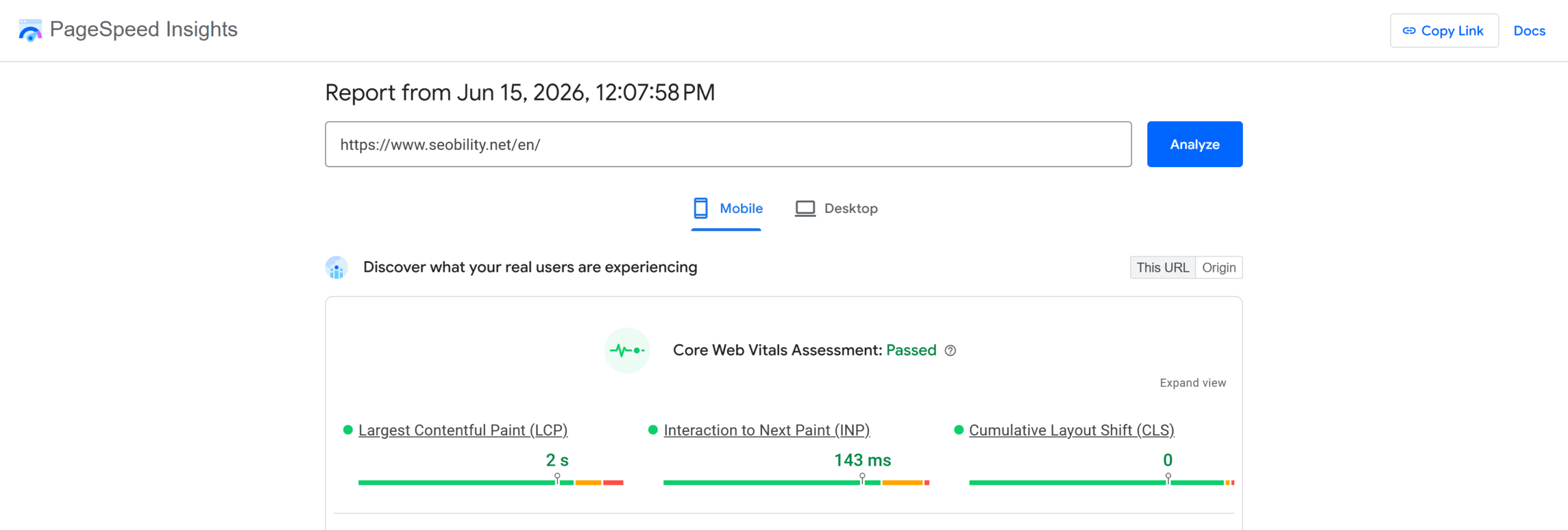
Your goal: all three values need to be in the “green zone” to meet Google’s technical requirements and lower your bounce rate.
What you can do specifically:
- Compress images before uploading (tools like TinyPNG help)
- Don’t load unnecessary WordPress plugins or scripts
- Choose a fast hosting provider
For a deeper dive, see our in-depth guide to page speed optimization.
Schema markup for medical practices
Schema.org markup (also called structured data) gives search engines extra information about your practice in a standardized format. That way, Google immediately understands that this is a medical practice, where it’s located, when it’s open, and what services it offers. The markup helps search engines correctly recognize your practice as an entity, for example for local search and the Knowledge Graph.
For medical practices, these schema types are especially relevant:
- MedicalBusiness (or MedicalClinic): Practice name, address, phone, hours, and specialty.
- Physician: Profiles for individual doctors with their qualifications and specializations
- FAQPage: Marks up question-and-answer blocks (see the FAQ tip above) and helps search engines and AI systems clearly recognize this content as questions and answers.
- Review or AggregateRating: Marks up reviews.
Structured data can affect AI search, too: systems like ChatGPT, Perplexity, and Google Gemini process page content, including embedded schema data. Clearly structured, well-marked-up content makes it easier for them to capture your information.
To implement it, you can use WordPress plugins like Rank Math or Yoast SEO, which generate the markup for common types (LocalBusiness, FAQPage, Review) automatically. (Neither plugin generates the Physician type automatically, so that one needs your own JSON-LD.)
Optimizing for mobile
Many searches now happen on a smartphone. If your website doesn’t work flawlessly on mobile, you lose the majority of your potential patients. Search engines care about mobile as well. Under mobile-first indexing, Google pushes pages that aren’t mobile-friendly down the rankings.
What you should check:
- Is your website easy to read and use on a smartphone?
- Are buttons and links big enough to tap?
- Can people reach your contact form or phone number with a single tap?
Regular website audits
Your website is the face of your practice online, and it never stops changing: new services, updated team pages, fresh practice news. With all these ongoing changes, technical SEO issues often creep in unnoticed, such as orphaned pages or broken links to important treatment details.
To keep from losing visibility, run a full SEO audit of your site periodically. That way, you’ll catch new 404 errors, missing meta data, or indexing problems in time, before they hurt your ranking.
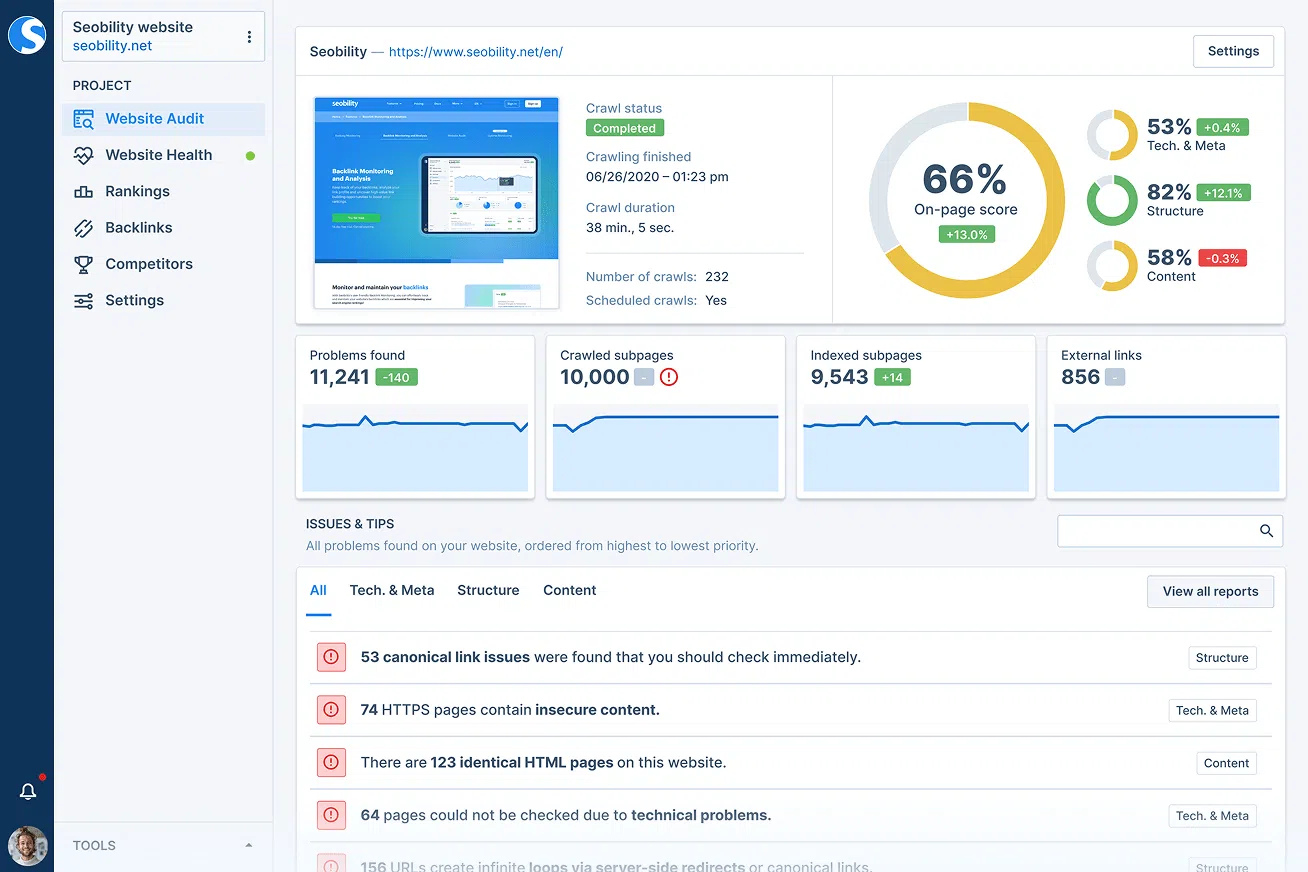
For the technical review, Seobility’s Website Audit is a great fit. The tool analyzes your entire practice presence and lists every weak point sorted by priority, complete with practical instructions for fixing them. If you just want to test a single service page first, the free SEO Checker by Seobility gives you a quick initial assessment.
4. Off-page SEO: building authority and trust for your practice
Google judges your website not just by its own content, but also by your reputation across the rest of the web. Backlinks (links from other sites to yours) work like digital recommendations: if experts link to you, you’re seen as relevant and trustworthy. In healthcare especially, Google puts a lot of stock in these links, and one rule holds: quality beats quantity.
Here are three effective ways to build high-quality backlinks for your practice:
- Listings in professional directories and associations: Set up profiles with bodies like the American Medical Association, your state medical society, or specialty associations (e.g., the American Academy of Dermatology). These links carry real weight in your field and give your E-E-A-T profile a serious lift. Well-optimized profiles on platforms like Healthgrades and Zocdoc matter just as much.
- Guest posts in trade and health media: Write informative articles for medical how-to portals. A guest article on “preventing cardiovascular disease” on a local portal earns you a valuable backlink and puts you directly in front of potential patients.
- Content with real value (link magnets): Create content that others want to cite. That could be prevention checklists, digital guides to specific conditions, or infographics about treatment procedures. The more exclusive and useful your content is, the more often other health sites will link to it as a source.
💡 Tip: For the full strategy, see our in-depth link building guide.
5. Generative Engine Optimization (GEO): how to get found by AI tools like ChatGPT and Gemini
More and more patients are turning to AI tools like ChatGPT, Perplexity, and Google Gemini for their health questions, instead of (or alongside) a traditional Google search. According to Rock Health’s 2025 Consumer Adoption Survey, 32% of U.S. adults have now used AI chatbots for health information, double the share from a year earlier, and most of them turn to these tools weekly. Some even act on the answers: 18% reported adjusting their medications after an AI interaction. The takeaway for physicians is clear: rely on traditional SEO alone, and you’ll gradually lose reach.
The good news: GEO and traditional SEO reinforce each other. If your website is technically sound, you’ve already laid the groundwork. With a few targeted tweaks, you can make sure AI systems recognize your expertise and, ideally, cite you as a source:
How to optimize your medical content for AI search
- Lead with the answer: Start each paragraph with the key message or the direct answer to a patient question. AI tools prefer a clear hierarchy and tend to pull facts from the start of a section.
- Keep each section self-contained: Write compact paragraphs that stand on their own. The better a section covers a specific medical topic, the more likely an AI is to serve it up as a solid answer. The same logic applies to Featured Snippets.
- Clear sentence structures: Use short sentences (subject, verb, object). That helps not just the AI language models but also your patients, since it makes medical topics much easier to understand.
- Use lists and tables: Whether it’s treatment steps or symptom checks, clearly formatted content helps AI understand how things connect and reproduce them accurately.
- Consistent terminology: Stick to the same terms for your specialty and your services. That helps AI connect your practice to what you specialize in.
- Evidence over fluff: Back up your claims with concrete facts and data. AI systems treat sources as more trustworthy when they’re objective and transparent.
Here’s an example of what that can look like:
- Empty phrases: The opening contains no real information.
- No separation: Services and contact info are mixed together.
- Vague: “Promptly” isn’t hard data an AI can extract.
By phone ((312) 555-0123) or through our online portal. We answer email inquiries within 24 hours.
- Skin cancer screenings
- Laser (pigmentation issues)
- Acne & eczema
- Keyword focus: The context is defined clearly right away.
- Data precision: “Within 24 hours” is an extractable fact.
- Structure: Subheadings allow clean categorization.
💡Tip: Invest in YouTube content, too. An SE Ranking study of more than 50,000 healthcare searches found that YouTube is by far the single most-cited source in Google’s AI Overviews for health topics, ahead of every hospital network, government health portal, and medical association. For you, that means a few short explainer videos on your own practice channel can go a long way toward getting you mentioned in AI answers, especially for common patient questions.
Conclusion: SEO isn’t optional for doctors
If you want your practice to be found online, there’s no way around SEO. Local optimization, solid content, technical fundamentals, and AI optimization are what build lasting visibility. Here’s a recap of the most important points:
Key takeaways: SEO for doctors
Want to find out how your practice website is really doing? Try Seobility free for 14 days and find your biggest opportunities in minutes.