In this post
SEO for New Websites in 2026: How to Get Found When You’re Starting From Zero
- The Core Issue: A brand-new website starts with no domain history, no backlinks, and slow initial indexing, and AI Overviews are cutting click-through rates on generic informational content even further.
- The Solution: Work through three pillars in order: fix technical SEO in week one, publish long-tail content with a clear point of view that matches search intent, then build brand mentions and authority through digital PR, Reddit, and partnerships.
- Quick Win: Skip straight to Your first 90 days: a starting plan. It maps out your technical, content, and link-building priorities month by month.
Launching a new website in 2026 is harder than it has been in years. You’re starting with no rankings, no backlinks, and no track record with Google. On top of that, AI Overviews now answer many queries before the user ever clicks through to a website. So even when you do start ranking, the click‑through rate isn’t what it used to be.
The good news: SEO still works for new sites, and many of the basics still do apply. This guide walks you through, step by step, what to focus on in your first months online, so you don’t waste time on any tactics that don’t matter.
We’ll cover:
- The specific challenges of being new in 2026, and what to expect
- The technical foundation every new site needs in week one
- How to make on‑page SEO and content work in a world full of AI-generated content
- Why links and brand mentions matter more than ever and how to earn them
- A first‑90‑days plan you can actually follow
What’s actually hard about SEO for a new website in 2026?
Most SEO advice you’ll read assumes you already have something to work with: existing rankings, an email list, a few months of search data. As the owner of a brand new site, you start with none of that. Here’s what makes the first 6 to 12 months different – and why your priorities should be different too:
- No domain history. Google takes time to figure out whether a new site is trustworthy. Expect 3 to 6 months before your signals stabilise.
- Zero backlinks. Links from other sites to yours is the pillar that has grown most important in the AI era, and it’s also the one where you start with nothing.
- Empty Search Console. You won’t have impression data, query data, or click‑through history to learn from for the first few months. You’ll be starting from scratch.
- Slow initial indexation. Don’t panic if Google takes weeks to crawl new pages. New domains tend to get less crawl attention until they’ve proven themselves.
- Day‑one choices that compound. Your domain name, CMS, hosting, and basic site structure all become harder to change later. It’s worth choosing well now.
- Tight budget. You probably can’t do everything at once. Prioritise: technical foundation first, then a small set of strong content pages, then links and brand signals.
- AI Overviews squeezing classic search traffic. Especially for informational queries (more on this in the next section!).
If that sounds discouraging, it’s not meant to. It’s meant to be an honest reflection of doing SEO in 2026. Ultimately, not a huge amount is different, but some sites may find it hard to win coverage if they’re not careful.
A quick orientation: what SEO is in 2026
If you already know what SEO is, skim this. If you’re new to it: search engine optimisation is the work of making your website easier for search engines to discover, understand, and recommend. Done right, it brings you visitors who are actively searching for what you offer, which makes them some of the most valuable traffic you’ll ever get.
Two things are different about SEO in 2026:
- The search landscape is more fragmented. Google still dominates, but ChatGPT, Perplexity, Gemini, and AI Overviews inside Google itself are all places people now go for answers.
- AI Overviews have changed the math for informational queries. If your new site’s plan was to revolve around “how to” articles and generic informational guides, expect AI Overviews to cap how much traffic those pages can earn. If you sell products or services, you’re less directly affected, but you still need to be visible to the AI engines that increasingly recommend brands.
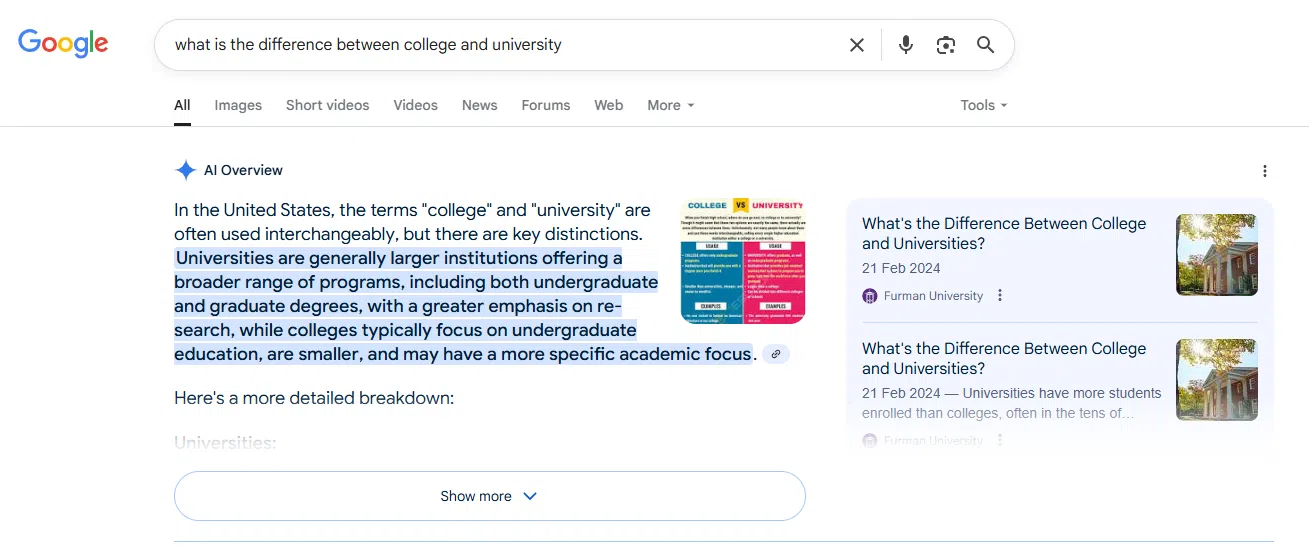
Google’s AI Overviews take away much of your potential traffic for informational queries
Throughout this guide, we’ll touch on what each step means both for classic search and for AI search.
The three pillars of SEO
Good SEO has historically come down to three things, and that’s still true:
- Technical SEO: a website that search engines can crawl and understand
- On‑page SEO: content that’s genuinely worth reading on the topic someone searched for
- Off‑page SEO: links and references to your site from other trusted places
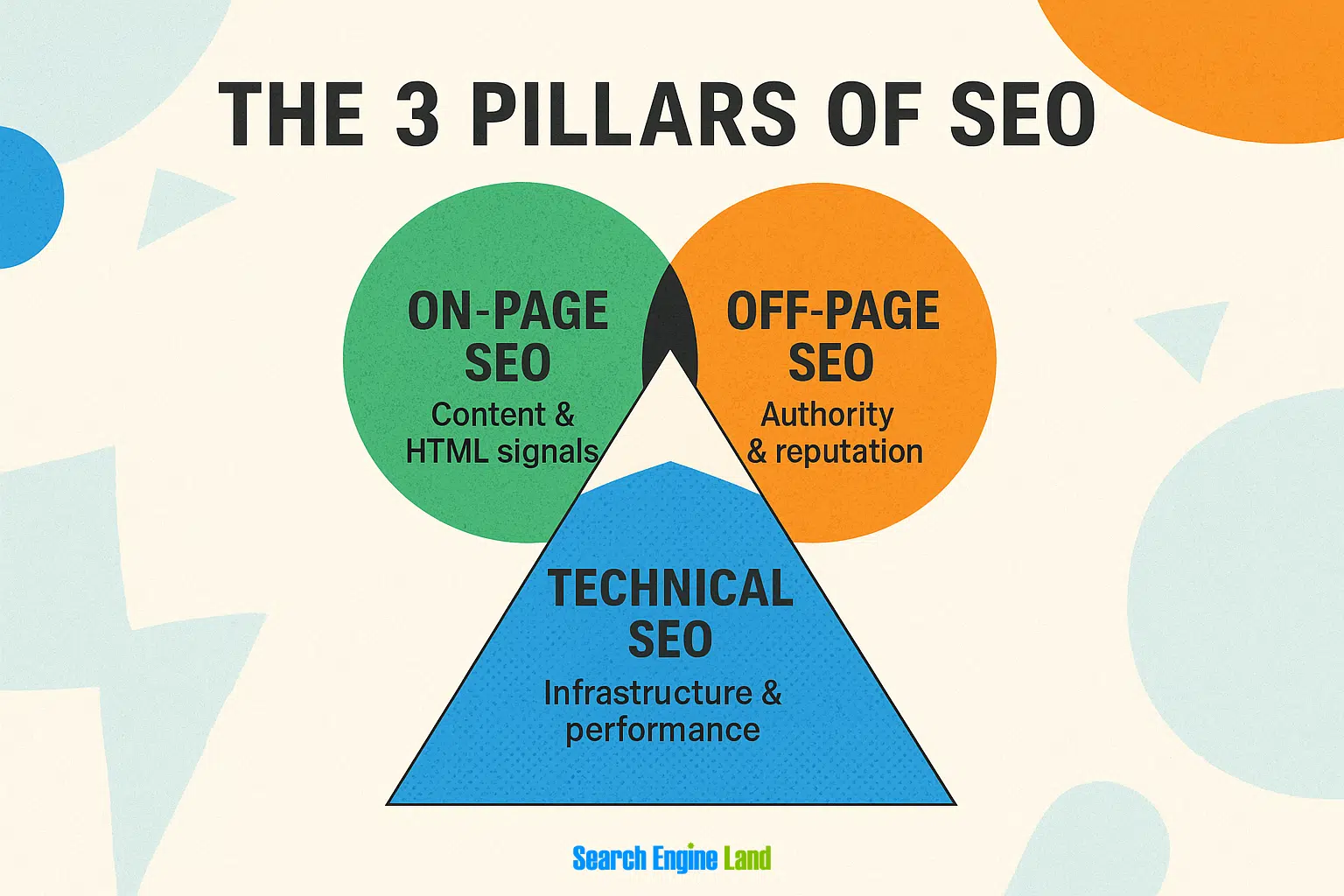
The three pillars of SEO — image via SearchEngineLand.
For a new website, the order matters. Get the technical foundation right first – without it, the other two pillars can’t work. Then build a small but strong set of content pages. Then start earning links and brand mentions. The rest of this guide walks through each pillar in that order.
Pillar 1: Technical SEO – your week‑one foundation
Modern CMS platforms like WordPress and Shopify are reasonably solid out of the box, which is good news – you don’t have to build search‑friendliness from scratch. But “reasonably solid” isn’t the same as “done”. Every new site still needs a basic technical SEO audit.
Your week‑one technical checklist
- Set up Google Search Console. Google Search Console is Google’s free tool for website owners. It shows you whether Google can find and index your pages, which search queries your site appears for, and if there are any technical issues that could affect your visibility. For a new website, this is one of the first tools you should set up because it gives you direct feedback from Google.
Start by claiming both the URL prefix property, which covers one specific version of your site, and the domain property, which covers everything under your root domain. Together, they give you complete visibility. Once your property is verified, submit your XML sitemap here too. - Check your robots.txt. This is the file that tells search engines which pages they’re allowed to crawl. Make sure it isn’t accidentally blocking access to your website for search crawlers.
- Make sure your important pages are indexable. Look for stray noindex tags. A page with one won’t appear in search results, no matter how good it is.
- Add self‑referencing canonical tags. A canonical tag is a small piece of HTML that tells Google “this is the main version of this page”. For a new site, self‑referencing canonicals are the safest default and head off duplicate‑content issues.
- Plan your redirects. Whenever you want to change the URL of a page that has traffic or links pointing to it, set up a 301 (permanent) redirect to its successor. Don’t break links.
- Check page speed. Aim for under 2.5 seconds to load on mobile. Slow pages lose both rankings and visitors. You can check your website’s loading times with Google’s own PageSpeed Insights.
- Make sure the site works on mobile. Google primarily ranks the mobile version of your pages, so test on a phone, not just on a desktop.
- Run a first audit. A tool like Seobility’s Website Audit crawls your site the way Google does and flags issues you’d otherwise miss – broken links, missing canonicals, SSL problems, noindex pages, missing meta tags, and many more. It then creates a prioritized list of recommended SEO fixes, so you can optimize your site step by step.
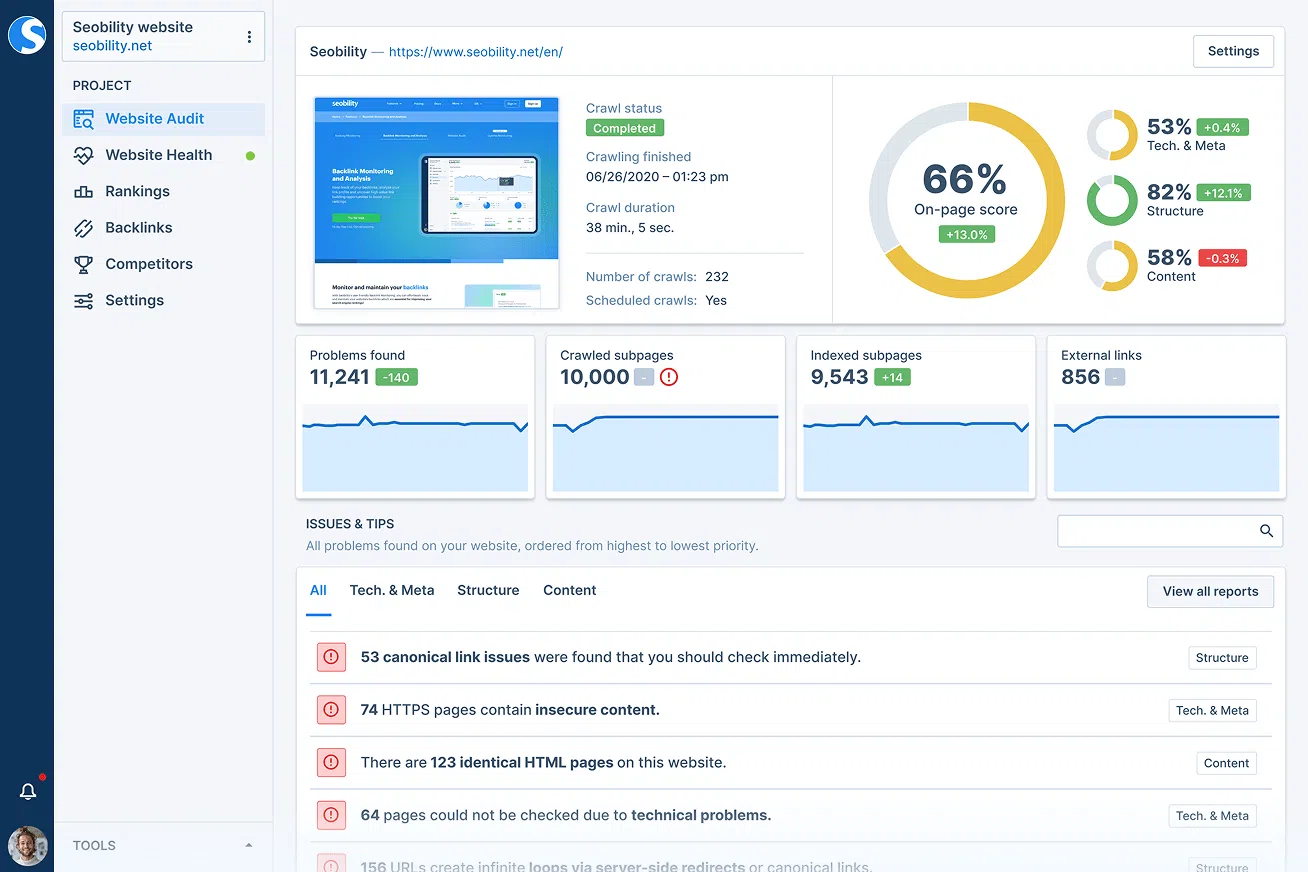
Having a website with serious technical issues is a bit like building a house on a cracked foundation – you can decorate it beautifully, but the foundation problem catches up with everything else eventually. Fix it early, while there’s not much site to maintain.
Pillar 2: On‑page SEO – content that earns its place
A lot of SEO advice from the pre‑AI era treated content like a volume game: cover every angle of your topic, publish often, hit the right keyword density, “own” the topic with 360‑degree coverage. Most of that advice has aged pretty badly.
Bland, generic, “covers everything but says nothing” content is dead. AI Overviews now do that job – faster, more concisely, and for free. If your new website’s plan is to compete on volume of generic informational content, you’re going to lose.
The opportunity for a new site is the opposite. Write fewer pages, but make each one say something. Pages with a clear point of view, real experience, and specific recommendations are the pages that earn links, get cited by AI engines, and convert visitors into customers.
Here’s how to put that into practice.
1. Do realistic keyword research
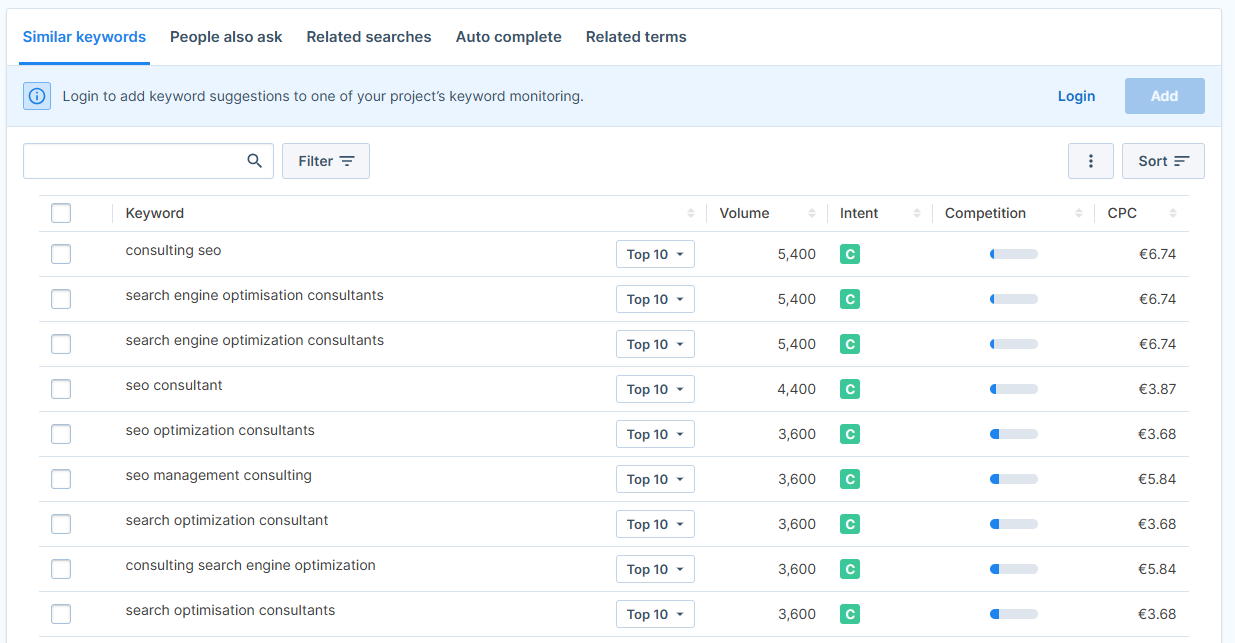
When you have no domain authority yet, going after big head terms is hopeless. A new SEO consultancy in Bristol won’t rank for “SEO consultant” anytime soon. But “SEO checklist for solo founders” or “how to choose an SEO consultant as a service business” might be reachable in months, not years.
Look for long‑tail keywords: longer, more specific search phrases with low difficulty and clear intent. A tool like Seobility’s Keyword Research Tool lets you see search volume and competition side by side, so you can pick keywords where a new domain has a realistic shot.
For more specific guidance, check out this full keyword research guide.
2. Match the search intent on every page
When someone searches for “best running shoes for beginners”, they want a comparison article – not your homepage about your personal training business.
When they search for “running coach Manchester”, they probably do want to see that homepage (assuming you are based in Manchester!). So before writing any page, look at what’s currently ranking for your target keyword and ask yourself: am I producing the same kind of content? Is the content I am producing going to match the users’ search intent?
You can find more details in this guide to optimizing for search intent.
3. Get the on‑page basics right
Once you’ve chosen a realistic keyword and understood the search intent, the next step is to make sure your page is clearly structured for both readers and search engines.
On-page SEO doesn’t have to be complicated, especially for a new website. The goal is simple: every page should make it immediately clear what it is about, who it is for, and why it deserves to rank for the topic.
Use this checklist for every important page you publish:
- A clear, specific title tag that reflects what the page is actually about. Aim for around 50–60 characters so it doesn’t get cut off in Google’s search results.
- A strong H1 heading that matches the promise of your title and reassures visitors that they’ve landed in the right place.
- Introductory content that confirms the reader is in the right place. Make it clear what the page covers and what the reader will get from it.
- Helpful sub-headings (H2s and H3s) that break up the content and guide readers through the page step by step.
- 2–3 internal links to related pages on your site, so readers and search engines can discover more of your content.
- A compelling meta description of around 140–160 characters that gives people a reason to click when your page appears in the search results.
These elements won’t make a weak page rank on their own. But they make it much easier for Google, AI search engines, and real visitors to understand your content, which is exactly what a new website needs.
4. Have a point of view
Compare these two openings for the same page:
Generic
There are many factors that affect website rankings on Google. It’s important to follow SEO best practices to ensure your site performs well.
Opinionated
Most of what you’ll read about Google rankings is overblown. For a new site, three things actually matter: get the technical basics right, write pages that answer a real question, and earn real‑world links. Everything else is noise until those three are in place.
The second is the version a reader remembers – and the one another website might link to, because it actually says something.
A practical test: if you can replace your business name on the page with a competitor’s name and the page still makes sense, your page is too generic. Rewrite until it could only have come from you, at least if you want to stand out!
Pillar 3: Off‑page SEO – links and brand mentions
If technical SEO is the foundation and on‑page is the building, links and mentions are how the rest of the world hears about you. Search engines and AI engines both use them to figure out who’s worth trusting – the more high‑quality backlinks your site has, the more visible you become.
For a new website, off‑page work is also the pillar with the biggest gap to close, since you start with zero. That’s why most of this section is about earning links the slow, honest way and not through buying them.
Avoid buying links and avoid agencies that promise “X links per month”. At best you waste money, at worst you get your new site penalised. Use the time you’d spend on that for what follows.
We’ll focus on digital PR and partnerships here because they’re especially useful for building high-quality links. For a broader overview of link building tactics, read this full link building guide.
Digital PR: the most reliable link source right now
If you care about visibility in AI search, getting your business mentioned in real media like newspapers, niche industry publications, and established blogs is one of the strongest signals you can build. AI engines lean heavily on press and editorial content when deciding which brands to recommend.
Digital PR done as a beginner has three steps:
- Identify journalists who cover your space. Look at recent articles in publications your audience reads. Note the bylines. Build a simple list: name, publication, what they cover, contact info.
- Build an angle. What story does your business have that a journalist would want to tell? It’s almost never “we exist”. It’s a data point, a counterintuitive observation, a seasonal hook, or a useful tip aimed at the publication’s readers.
- Send the pitch. Short, specific, and clearly relevant to that journalist’s beat.
Finding the right angle is the hardest part of this process. I once pitched a piece called “Top 5 tips on saving on your energy bills this winter” on behalf of a loft insulation company. Several UK tabloids picked it up, which earned the company strong mentions and a handful of high‑authority links. The angle (winter, energy bills, practical) gave each journalist a ready‑made article they could publish; the brand mention came along for the ride. The same approach works whether you’re pitching for a client or for your own business.
Where to find journalists looking for sources
Some journalists actively look for experts to quote. Two easy places to find them:
- On X (formerly Twitter), the #journorequests hashtag is still used, though less than it once was.
- A paid service like Qwoted connects journalists directly with sources. There is a small monthly fee to use this service, but it might be worth it, depending on your industry.
The goal isn’t to land one quote and disappear. It’s to become the helpful, reliable source two or three journalists keep coming back to. That takes time, but it’s how meaningful media presence is actually built.
Press releases are mostly dead – partnerships aren’t
Mass‑blasted press releases are a tactic from a previous media era. Most journalists today don’t read them, much less act on them.
What still works is real partnerships. Instead of approaching another business with “if we link to each other, our SEO will benefit” – a transaction nobody enjoys – think about which businesses your audience already trusts, and what useful thing you can build together. A guest post, a joint webinar, a co‑branded resource. The link follows the value, not the other way around.
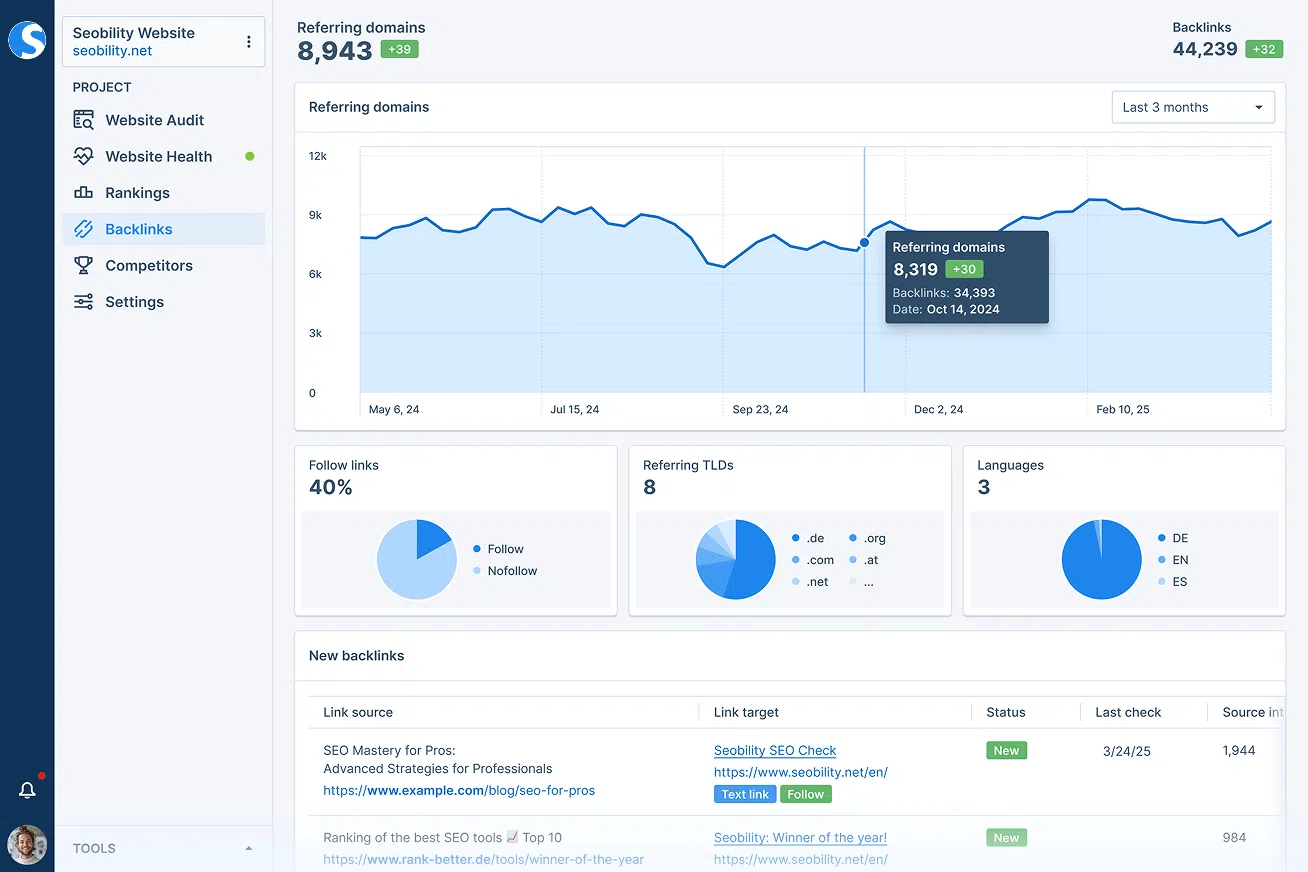
Tools like Seobility’s Backlink Monitoring let you track which links you’ve actually earned, and watch the trend over time. For a new site, this is one of the most motivating dashboards you’ll have, as every new referring domain is a real signal that your work is paying off.
Pillar 3 extended: Brand and social – the long compounding game
The most reliable way to grow your organic traffic over the long term is to build your brand – this has consistently held true, and AI search has made it more important, not less.
Three reasons brand work feeds SEO directly:
- People search for you by name. Once they know your brand, they’ll type it into Google to find you. This branded traffic is the easiest you’ll ever capture, and for established brands it often makes up a large share of total organic visits (frequently cited as 40–70%, depending on the niche).
- Branded search volume is itself a trust signal. When lots of people search for your brand by name, Google reads that as a sign you’re a known, valued entity, which lifts how it ranks the rest of your pages.
- AI engines need to know you exist before they recommend you. They build their recognition of brands from mentions across the web – articles, forum posts, social content. If your brand is invisible in those sources, AI engines probably won’t suggest you even when your product is exactly what someone asked for.
How to do brand work as a new website with limited time
Pick one or two social platforms and show up consistently. Don’t try to be on all of them. For most B2B and service businesses, that means LinkedIn. For consumer brands, often Instagram or TikTok. The platform matters less than the consistency – a year of useful posts on one platform beats six months of half‑effort on four.
LinkedIn is also worth singling out: AI engines including Google’s AI Overviews regularly cite LinkedIn posts when answering professional or industry questions. That gives long‑form LinkedIn content a real second life as an AI‑visibility tool.
Use Reddit thoughtfully
Reddit has a licensing deal with Google, which means Google trains its AI on Reddit conversations. Brand mentions in relevant subreddits – even just from helpful, useful contributions – can directly influence whether AI engines mention you.
A starter playbook for Reddit:
- Find the 2–3 subreddits your audience actually hangs out in. Search Reddit for terms related to your product or industry; the active subreddits surface quickly.
- Lurk for a week. Read what gets upvoted and what gets removed. Every subreddit has its own rules and culture. Ignore them, and you’ll get banned fast.
- Start commenting helpfully. Give actual answers to questions, no links, no self‑promotion.
- After you’ve built a reputation, you can occasionally mention what you do, when it’s genuinely useful to the person asking.
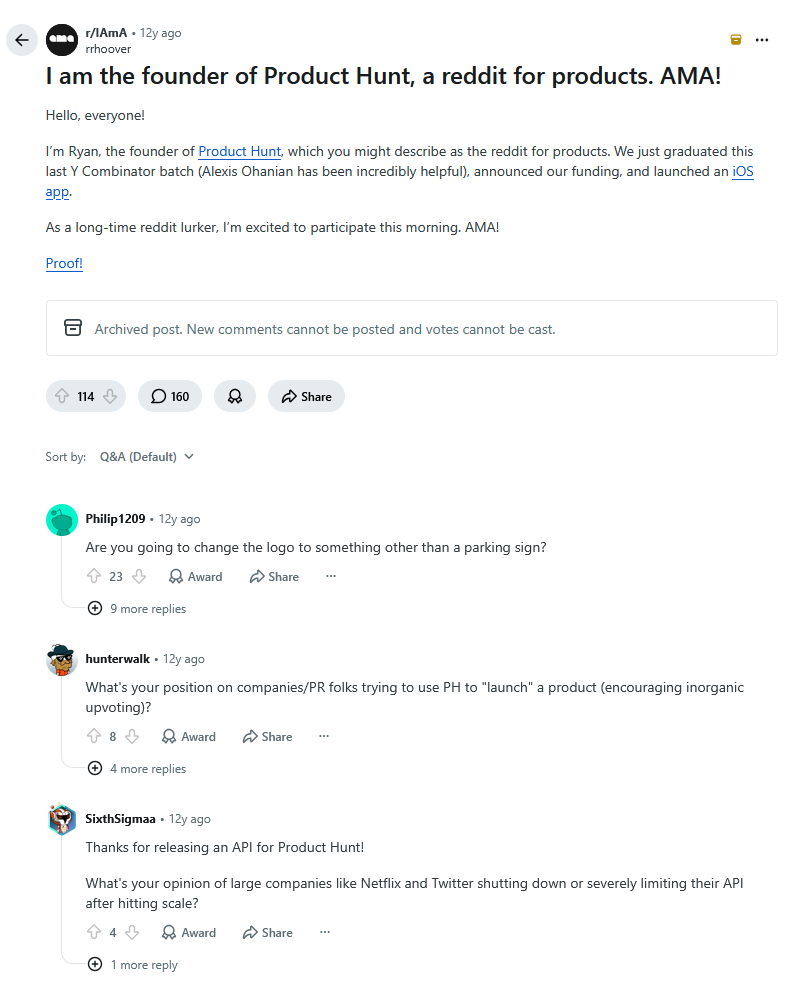
- For a real attention spike, consider hosting an AMA (“Ask Me Anything”) in a relevant subreddit once you have a story worth telling. Founders have used this format to launch products – see, for example, the Product Hunt founder’s classic AMA.
The same rule of thumb applies everywhere on social: don’t post to self‑promote – post to be useful. The brand benefit follows automatically.
Your first 90 days: a starting plan
If you’re launching a new website right now, here’s a realistic order of operations:
Week 1: Technical foundation
- Set up Google Search Console (both URL prefix and domain property)
- Submit your XML sitemap
- Check robots.txt isn’t blocking important pages
- Run a first Seobility Website Audit and fix anything flagged as critical
- Verify the site is fast on mobile (under 2.5s) and renders correctly on a phone
Weeks 2 – 4: Core content
- Identify 5-10 keywords with low difficulty and clear intent, where a new domain has a real chance
- Build out your most important 5-10 pages – clear titles, intent‑matched content, one strong H1 each, 2-3 internal links per page
- Write each page with a clear point of view; don’t mass‑produce or be tempted to outsource to AI
- Set up meta titles and descriptions to earn the click
Months 2–3: Brand and links
- Pick one social platform where your audience hangs out and start showing up consistently
- Identify 3-5 journalists in your niche and write your first digital PR pitch
- Find 2-3 relevant subreddits and start contributing helpfully
- Look for one podcast or guest‑post opportunity per month, or look out for journalist requests you can answer
Ongoing: Track and adjust
- Watch branded‑search volume grow in Search Console – this is your trust‑signal flywheel starting
- Track which pages pick up impressions; double down on what’s working
- Use Seobility’s Backlink Monitoring to check what links you’re earning
- Be patient. Real organic compounding for a new site usually kicks in around month 6 and accelerates from month 12 onwards.
One last thing
SEO for a new website hasn’t actually changed that much over the years – the same three pillars still hold. What’s changed is the weighting. Technical SEO matters as much as it always did. On‑page content still matters, but it depends on the kind of content you are producing. And links and brand mentions, which used to be the third leg of the stool, are now the leg most likely to make or break your visibility in both classic and AI search.
The websites that win at this aren’t the ones that chase every new tactic. They’re the ones that get the basics right, write things worth reading, and show up consistently for a year before expecting compounding to kick in. If you can do those three things, you’re already ahead of most new websites launching in 2026 and beyond.