
If you search on Google today, the results will probably look completely different than they did just a few years ago.
Instead of ten blue links, you’ll often find an AI-generated summary at the top that condenses information from multiple websites and gives you a concise answer to your query.
These “AI Overviews” reflect Google’s move toward generative search: users can now get complete answers instantly without having to click through to other pages and search for the information themselves.
And Google is not alone: AI-powered chatbots like ChatGPT are becoming increasingly popular and they are massively changing the way people find information online.
While these developments make our lives a lot easier, they can be quite worrying from an SEO or website owner’s perspective:
If Google can answer users’ questions directly, how can you still attract traffic to your website? Is this the end of SEO?
Our answer is clear: SEO isn’t dead. It’s just evolving.
Instead of focusing only on clicks and rankings, you should start thinking in terms of Search Visibility Optimization: being visible and trusted within both AI-generated answers and traditional search results.
And fortunately, the foundations of SEO are also the keys to success in AI-generated answers.
In this article, we’ll explore how AI Overviews affect SEO and which strategies you should prioritize now to stay visible and successful with your business.
What are Google’s AI Overviews and how do they work?
Before answering the core questions of this article, we’ll take a quick look at how AI Overviews work, as this will help us grasp their impact on SEO.
What triggers an AI Overview?
Google’s AI Overviews are triggered only in certain cases, not for every search query. Google’s official documentation says:
“AI Overviews are only shown when our systems determine that it is additive to classic Search, and as such, often don’t trigger.”
In simple terms, this means Google only shows them when a quick, AI-written answer would help people understand a topic faster or more clearly than the regular blue-link results alone.

This typically applies to informational multi-faceted queries. For instance, a search like “best marketing strategies for small businesses” is more likely to trigger an overview than “current weather in Berlin.” A study by Semrush confirms that about 80% of queries that trigger an AI Overview are informational.
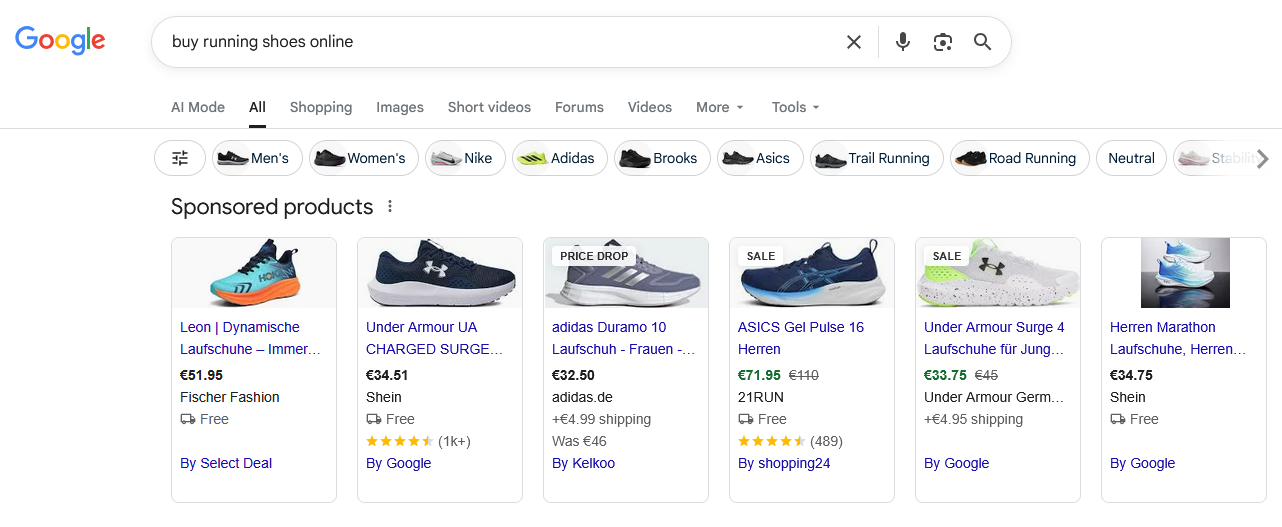
AI Overviews are much less common for other types of intent. Navigational queries (like “Facebook login”), transactional searches (like “buy running shoes online”), and local results (like “coffee shops near me”) usually show traditional results, shopping ads, or map listings instead of AI summaries.
How are sources selected for AI Overviews?
According to Google’s documentation and its PDF about AI Overviews, the summaries shown in AI Overviews are based on information from across the web.
Google’s AI systems do not generate answers entirely on their own. Instead, they rely on existing web content that has already been indexed and evaluated through Google’s core ranking systems – the same systems used for classic search results.
When an AI Overview is generated, Google’s algorithms identify relevant and high-quality pages related to the query and use them to create the summary.
The overview then includes citations and links that point to the original sources of the information displayed.

In short, the sources featured in AI Overviews are web pages that Google’s ranking systems have already evaluated as relevant and trustworthy for the specific query.
However, several independent analyses (including a recent study by researchers from University Bochum) show that AI Overviews don’t always use the exact same pages as Google’s organic results.
While they rely on the same ranking systems, the AI model sometimes cites additional or alternative sources. In fact, around 73% of sources used in AI answers also appear somewhere within the top 100 search results. This shows that there is a strong connection, but not a one-to-one match.
Also, AI Overviews are less predictable and more dynamic than classic search results, meaning that the sources can vary from one moment to another.
What does this mean for SEO so far?
From what we’ve covered so far, it’s clear that Google’s AI Overviews don’t replace the traditional ranking systems but build on top of them.
The AI model relies on the same quality and relevance signals that determine which pages rank organically, even if they don’t follow the exact same logic.
This means that SEO still plays a central role; it just needs to evolve.
The next section explores this in more depth, looking at how AI Overviews affect organic clicks but also offer new opportunities to make your business visible.
How do Google’s AI Overviews affect SEO?
Reduced organic clicks and zero-click searches
As Google increasingly provides answers directly on the results page, fewer users click through to external websites. This trend isn’t new, but the introduction of AI Overviews has accelerated it.
A recent SparkToro study (2024) found that nearly 60 % of Google searches in both the U.S. and the EU now end without any click to the open web.
This means that, in many cases, users get what they need directly from the results page without visiting a single website. Whether it’s through AI Overviews, featured snippets, or other rich elements
And further data suggests that if an AI Overview is displayed, this leads to fewer clicks on traditional search results. Multiple studies have reported this:
| Source / Study | Finding |
|---|---|
| Advanced Web Ranking (Q4 2024) | AI Overviews appeared in 42.5% of SERPs; CTR for top positions dropped by about 7.3 percentage points for informational queries. |
| GrowthSRC Media (2025) | CTR for the #1 organic result dropped from ~28% to ~19% (≈ 32% decline) after AI Overviews rollout. |
| ahrefs (2025) | AI Overviews correlated with a 34.5% decrease in CTR for top-ranking pages. |
While the exact figures vary depending on the dataset and search intent, all studies confirm a decrease in clicks when AI Overviews are shown.
So what does this mean for you as a website owner or SEO?
Don’t worry, your site isn’t becoming invisible. But the way people interact with your content is changing. Focusing only on clicks and traffic no longer tells the whole story. To understand your true visibility, you’ll also need to look at where and how your content appears across different parts of the search results, including AI-generated answers.
In the next section, we’ll look at what that means in practice and how being featured within AI-generated answers can still strengthen your online visibility and authority.
Visibility opportunities within AI answers
Even if your website doesn’t get as many clicks as before, it doesn’t mean your potential customers aren’t noticing you.
AI Overviews do open up new ways for your website to be visible, commonly referred to as “citations” and “mentions”.
- Citations: These are clickable links that point directly to your website. You’ll usually see them as small cards or source links below or next to the AI-generated summary. Being cited means Google used your content as supporting material for the answer, and users can click that card to visit your page.
- Mentions: Sometimes, Google’s AI will explicitly mention a brand, company, or product in the answer text. These mentions can occur with or without a citation link. While your brand will be highly visible to users, you may not receive direct traffic from it.
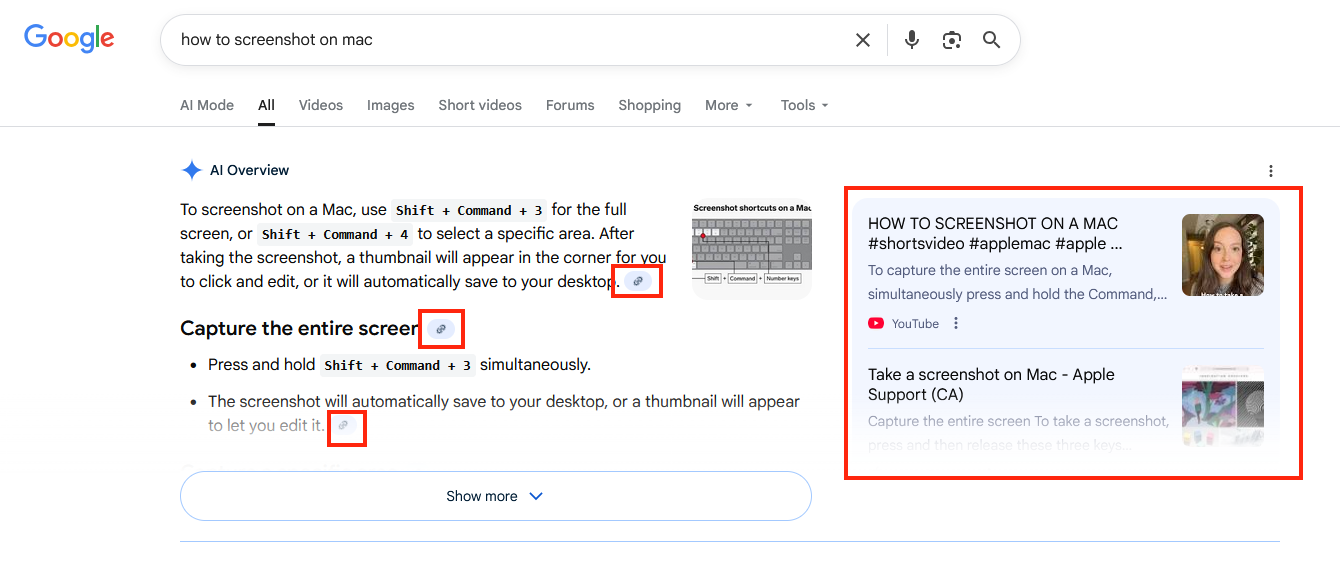

Both citations and mentions can increase your brand visibility and credibility:
- Citations increase both visibility and potential traffic: When users see your website listed as a source, it tells them that Google trusts your information. And some will click through to learn more.
- Mentions build brand awareness: Being named in an AI Overview helps users remember your brand. Over time, this can lead to more direct searches for your brand.
- Visibility signals authority: Whether through a citation or a mention, showing up in AI Overviews means Google considers your content high-quality and trustworthy. That’s an important signal, both for users and for your long-term SEO and marketing strategy.
How should you adapt as AI takes over search?
Now that we’ve covered the risks and opportunities that come with AI Overviews, let’s take a look at how you can adapt to this new environment. We will keep our explanations on a higher-level strategic level here. If you’re looking for an actionable step-by-step guide, check out our separate article on how to rank in AI Overviews.
Focus on clarity and structure, not on chasing a new acronym
You may have heard of terms like Answer Engine Optimization (AEO) and Generative Engine Optimization (GEO) lately. Both of them summarize practices that aim to improve your visibility in AI answers.
But don’t worry, they are not brand-new strategies that you suddenly need to learn.
AEO/GEO describes very similar principles to what you already know from traditional SEO, but viewed through the lens of AI-powered search. There are some changed priorities and new details to pay attention to, but they are not entirely different disciplines.
AEO focuses specifically on things like making your content easy for AI systems to use in their answers. But the best practices for this (keeping your content clear and concise, using clear headings and well-structured sections, implementing schema markup, etc.) have already been important for SEO and marketing in general for a very long time.
So instead of thinking about AEO as something entirely new, see it as SEO 2.0: the same good habits, just adapted for a world where AI can read and summarize your content in new ways.
To learn more about how to optimize your content for AI systems, head over to our guide on how to rank in AI Overviews.
Prioritize technical SEO
Even as Google’s search results change, technical SEO stays the backbone of your online visibility.
Before Google can use your content to create summaries or cite it in an AI Overview, it first needs to be able to find, crawl, and understand your website.
Technical SEO ensures that:
- Google can find and access all the important pages on your website.
- Your content is fast, secure, and mobile-friendly, which helps both users and crawlers.
- Your site communicates clearly through cleanly structured content, metadata and structured data, making it easier for Google to interpret your content accurately.
In short, a technically healthy website gives your content the best chance to be discovered, ranked, and even cited in AI-generated results.
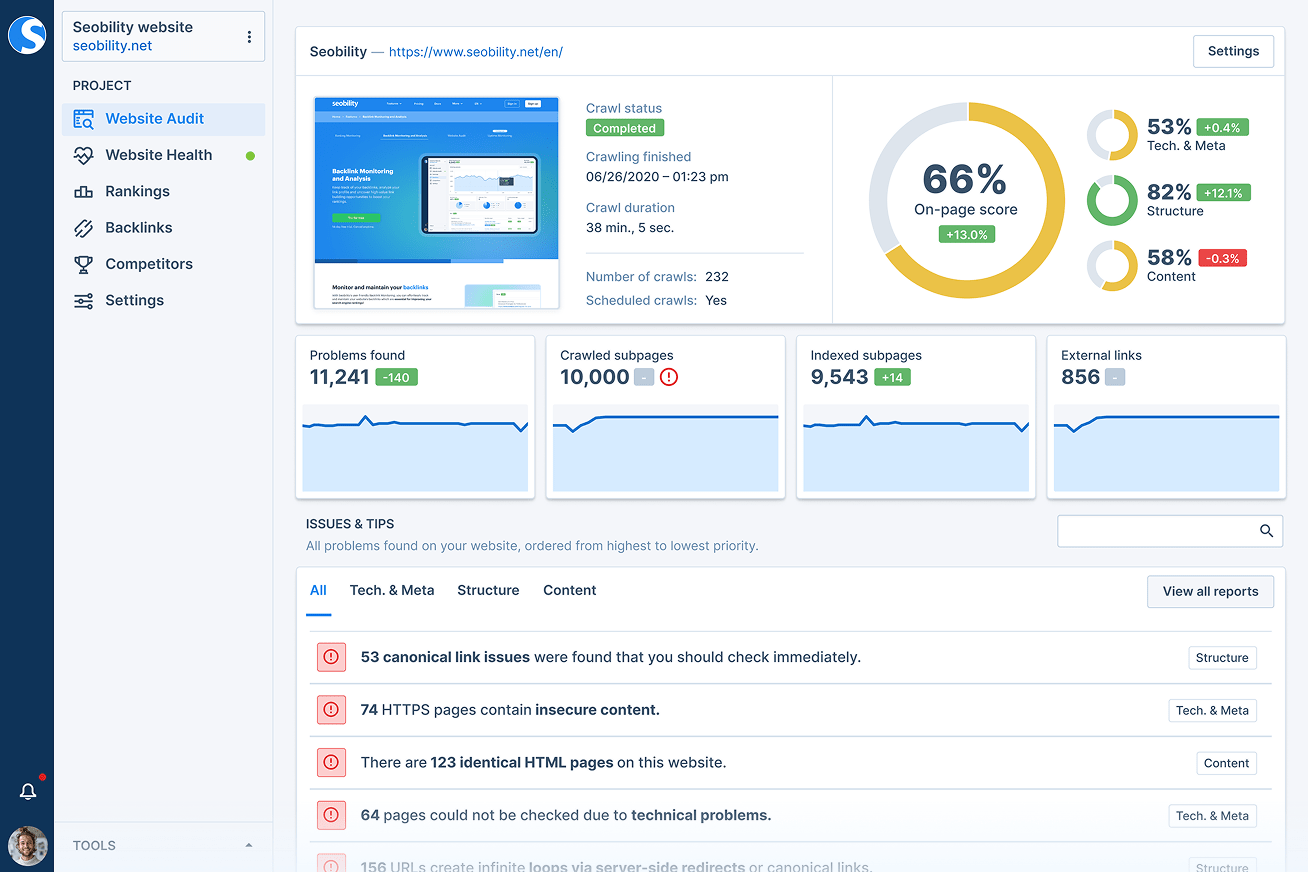
With Seobility’s Website Audit, you can easily analyze your website’s technical SEO and spot any issues that might prevent your website from being crawled and cited by Google:
Prioritize off-page SEO
While technical SEO helps Google find and understand your content, off-page SEO helps Google trust it.
Backlinks, mentions, and other signals from outside your own website tell Google and its AI systems that your content is reliable and valued by others. This kind of trust is essential when Google decides which sources to use for its AI-generated answers.
In practical terms, that means:
- Earning links from relevant and reputable websites remains one of the clearest ways to signal authority.
- Being mentioned in your industry, even without a link, strengthens your brand visibility and trust.
- Building a consistent presence across social media, local directories, and partner sites helps reinforce who you are and what you’re known for.
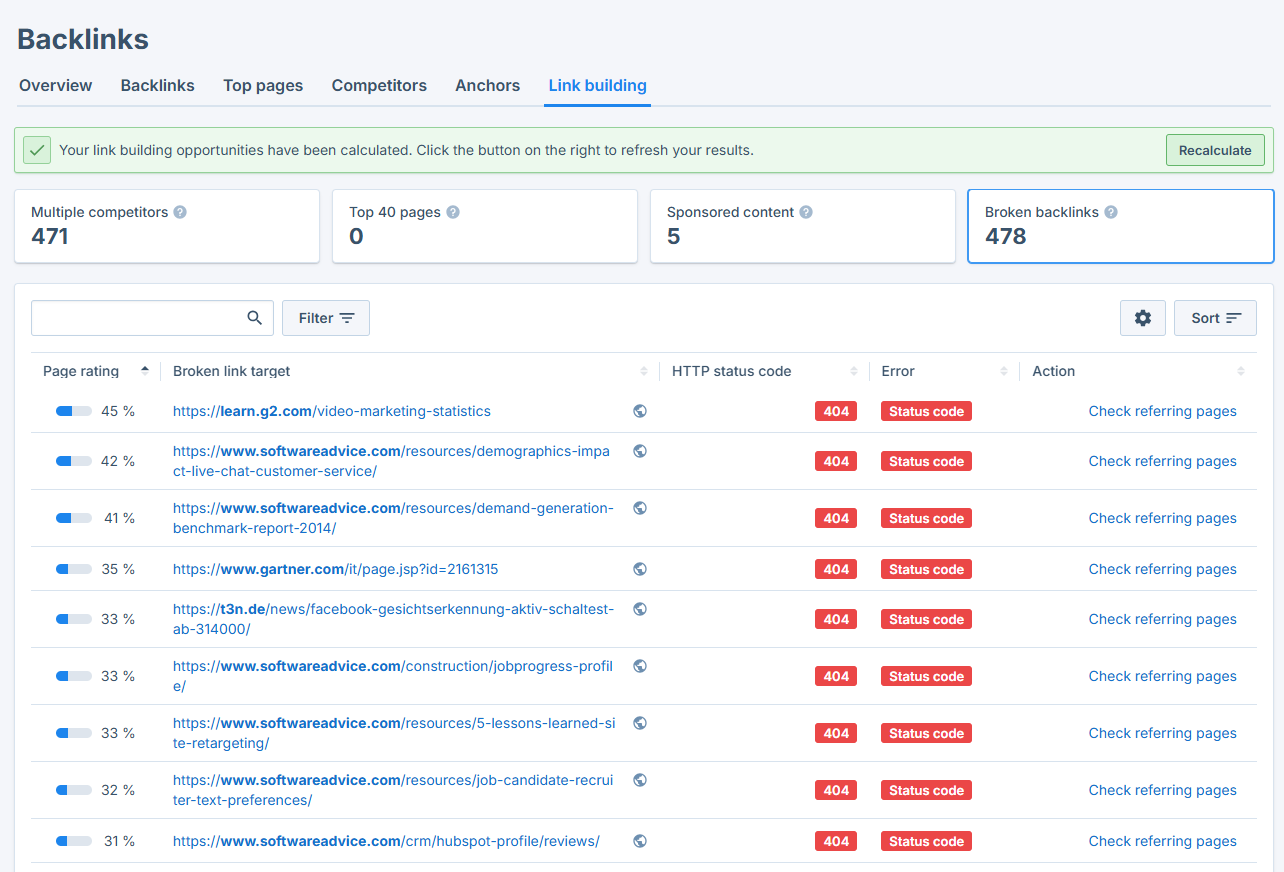
Seobility’s Backlink Monitoring lets you keep an eye on all the websites that link to yours and monitor the success of your off-page SEO efforts:

It also provides custom link-building opportunities for your website to help you build more links and improve your authority:
What type of content works in the age of AI answers?
AI Overviews don’t just cite whoever ranks first. Instead, they use pages that clearly explain a topic, add original value, and come from trustworthy sources.
Helpful, in-depth, and unique content is what earns visibility. If your content simply repeats what’s already on the web, it’s less likely to be considered unique or useful.
In fact, Google’s VP of Search just recently confirmed that Google expanded their spam concept to content that doesn’t show the creator’s unique perspective and depth. And she also explained that click patterns show them that users prefer rich and deep content with a unique perspective that doesn’t just repeat what everyone else is saying.
So focus on bringing your own insights, explanations, opinions, and real-world examples to every topic.
Think about what users still need to know after reading an AI-generated summary, and make sure your page provides that.
Should you stop producing informational content?
As we mentioned at the beginning of this article, AI Overviews mostly appear for informational searches, so these queries are most affected by fewer clicks. So it’s natural to wonder: if people can get their answer directly on Google, is it still worth creating informational content?
The short answer is yes, but pick your topics carefully. Always ask yourself if an AI could easily produce that same content before you start working on an article. If the answer is yes, you should probably invest your resources in other types of content.
Here’s an example from our own experience:
If you’re a long-term Seobility user, you’ve probably come across one of our wiki articles at some point. These articles provide easy-to-understand definitions of important SEO and marketing terminology, and they were an important traffic driver for our website for many years. But since the rollout of AI Overviews, this traffic has been declining rapidly:

And it makes total sense: if you’re looking for a quick and easy definition of any term, AI can easily provide an answer, and there’s no need to click through to another website.
So for us, the implication is clear. We’re not going to produce more wiki content, but instead going to focus on content where we can provide additional value beyond what’s already available on the web.
And you should do the same: Focus on creating content that AI and humans truly need: clear, helpful, experience-based information that adds something new to the topic.
When you combine that with solid technical SEO and trustworthy off-page signals, your informational content won’t just survive in the age of AI, but will help you define your authority.
Track AI visibility alongside classic SEO metrics
As AI Overviews become a regular part of Google Search, we have to adjust how we define and measure SEO success.
Traditional metrics like keyword rankings, visibility, and clicks are still important, but they no longer tell the full story.
Your website can now appear in new ways: as a cited source or mentioned brand inside an AI-generated summary.
That means your content might be helping users and they might remember your brand name even if they don’t visit your website directly. To fully understand your search visibility, you need to start tracking both: classic SEO metrics and AI visibility signals.
What to track
- Citations and mentions in AI Overviews: Keep an eye on whether your brand or content is cited and mentioned in AI answers. With Seobility’s AI Overview Tracking (which is part of our Ranking Monitoring), you can easily do that for all the keywords you are monitoring:
- Which pages and content types are being used: Note what kind of content tends to be cited. Is it guides, case studies, or original research? This will help you understand what works best in your niche. Remember what we covered above: Google adjusts the content displayed in AI Overviews according to users’ preferences. If you notice that the type of content cited is changing, it could indicate changing user preferences to which you should adapt.

With Seobility, you can not only analyze the complete AI Overview text, but also get a list of URLs cited in the AI Overview:

Apart from that, Seobility’s Ranking Monitoring continues to provide you with classic SEO metrics like your website’s rankings in organic results, so you can get a complete picture of your website’s visibility:
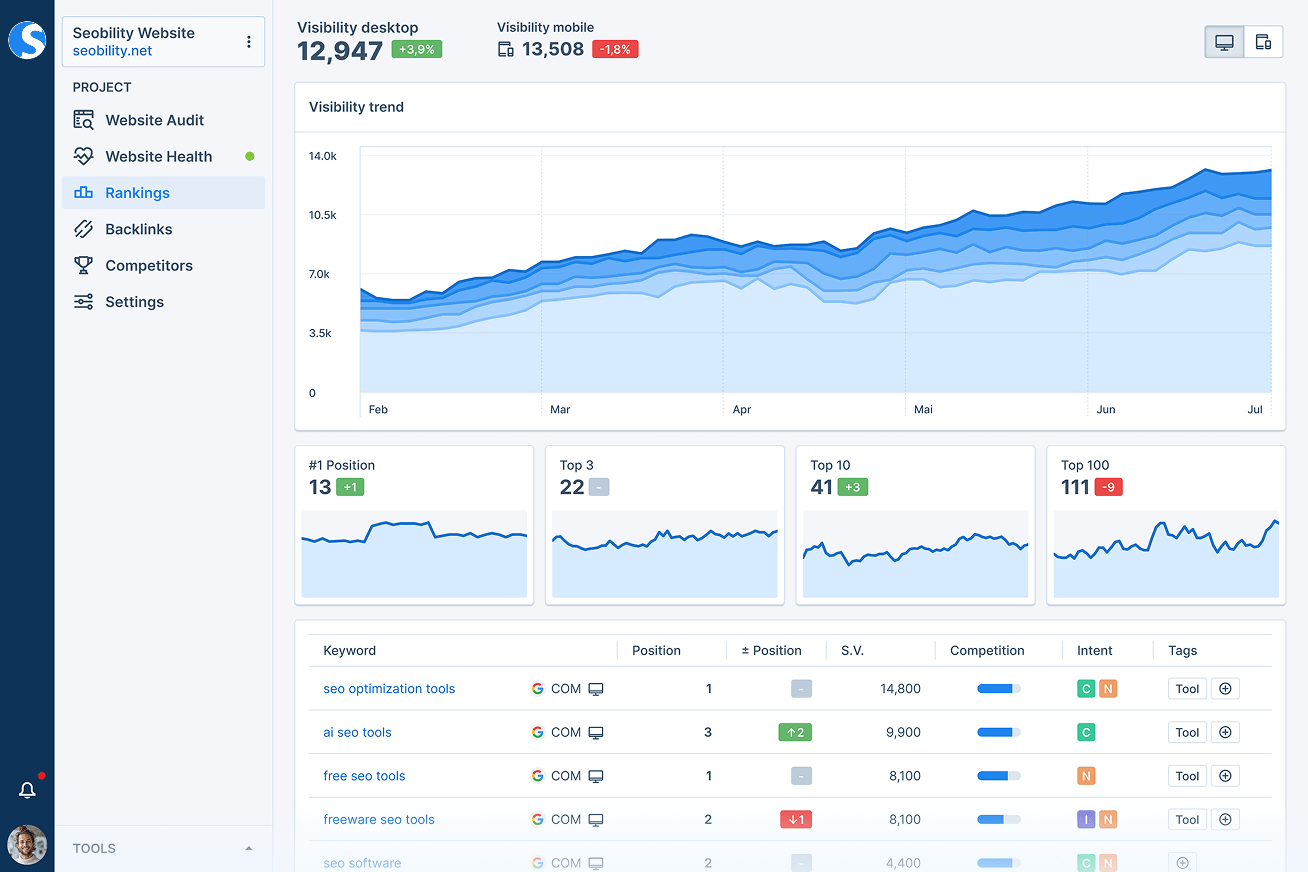
In short, visibility in 2025 is about more than just rankings and clicks. By tracking both traditional SEO metrics and AI visibility signals, you’ll get a more complete picture of your online presence.
Conclusion: What does the future of SEO look like with AI Overviews?
We’ve mentioned it several times throughout this article: AI Overviews are not ending SEO. They are redefining it.
We like to think of it as “Search Visibility Optimization”: the idea that success in search isn’t just about ranking, but about being visible wherever Google or other search systems present information.
Your website might appear as a link in the classic results, a source cited in an AI Overview, or a brand mentioned within an answer. All of these are valuable touchpoints that shape how users discover and perceive you.
The future of SEO belongs to those who embrace this broader view.
Your 5-step action plan for SEO in the age of AI
To summarize what we’ve covered above:
- Create genuinely helpful content: Focus on clarity, depth, and originality. Create content that deserves to be cited.
- Keep your technical foundation strong: Make sure Google and other AI systems can easily access, understand, and use your pages. Solid technical SEO is the base of your online visibility.
- Build and demonstrate authority: Earn links, mentions, and positive references across the web.
- Track visibility, not just rankings: Monitor how and where your content appears by combining classical SEO metrics with AI visibility tracking.
- Adapt continuously: AI search is evolving fast. Keep testing, learning, and improving, and stay open for what’s next.
If you’d like to test how Seobility can help you with these steps, you can sign up for a free 14-day trial here.